

Poor Man's Tarpon
Shad fishing is almost here so I thought I would start the juices flowing by posting this reprint of an article on American River Shad I did awhile back for Northwest Fly Fishing magazine.

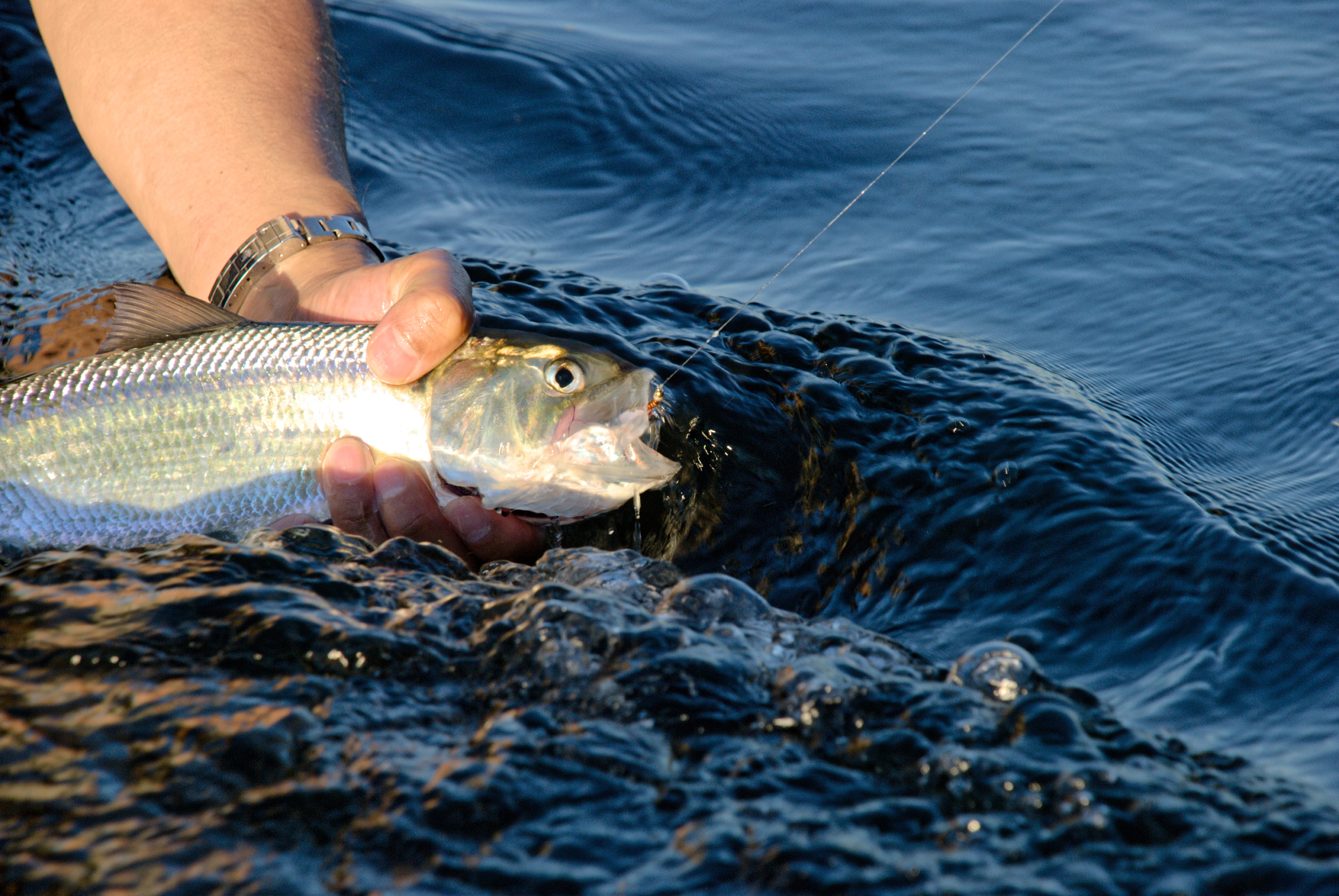
Wade Fishing for American River Shad
There is an old saying that “Shad don’t arrive until the Cottonwood is on the water”. That couldn’t be truer than on the American River which originates in the Sierra Nevada Mountains and runs through Sacramento, California. One of the most common questions in Northern California fly shops between the end of April and the end of May is “Shad in yet?” At the end of April it’s been about a month since American River fly fishermen have had anything to fish for, as Winter Steelheading has been over since about the end of March and the mountain waters won’t be fishable until sometime in June. Towards the middle of May, the Cottonwoods lining the river banks start dropping their pollen in clouds that look like falling snow flakes. This is when the Shad begin showing up and for many fishermen the their arrival will mean their first opportunity this Spring, to wet a line.

Shad are found in what is known as the lower American River, which is the section below the Folsom Dam/Nimbus Dam complex to its confluence with the Sacramento River in downtown Sacramento. Nimbus dam, which is located 23 miles from the confluence, blocks the migration of Shad and other anadromous fish such as Salmon, Steelhead and Striped Bass. They spend most of the year in salt water (they are one of the several species of Herring) and enter the Sacramento River system, which the American River is apart of, in the Spring to spawn.
American Shad were introduced into the Sacramento River system and it’s tributaries late in the 19th Century. They adapted well, and were harvested in marketable quantities by the 1920s. Following World War II, California embarked on a huge effort to improve its infrastructure, which resulted in the construction of many dams to provide electric power and store water needed by agriculture and the huge growth in population occurring at that time. Most dams were unfortunately built right at the location where the Sierra foothills meet the great central valley of California and they consequently blocked the historic migrations of anadromous fish such as Salmon, Steelhead and Shad from their traditional spawning beds. Though Shad are free spawners and do not require a gravel bottom to deposit their eggs like Salmon and Steelhead, the fact that the available habitat was somewhat diminished, had some affect on their numbers. Today their populations are mostly affected by the environmental conditions in the Sacramento River Delta which is located where the Sacramento River empties into the San Francisco Bay. Present in the delta are the giant pumps that pump Northern California water South to the thirsty cities of Southern California. Every time the pumps get reved up, they suck up water and resident juvenile Shad, and ship it all via the California Aqueduct to Southern California. Shad sucked up by the delta pumps are gone from the Sacramento River System (which the American River is apart of) forever and will never have the opportunity to return to the American River or any other Central Valley stream to spawn.
Shad can show up in the American River anytime from late April to the end of May. With the cooler Springs that we’ve experienced in Northern California over the past several years, the fish have tended to show up towards the end of May. First to enter the system are the smaller males closely followed by the females. Successful Shad fishing on the American River has as much to do with the river flows as any other factor. Flows need to be less than 4000 cfs for wade fishing but of course those fishing from boats can do well in much higher water. As most fly fishermen do not have access to a boat, years of high water can mean absolutely no Shad fishing for many. Usually the flows between March and June on the American are relatively light as this is the time between the blown-out conditions that are present during the heavy rains of Winter and when large amounts of water are released for agricultural irrigation in the San Joaquin Valley of California. Once June arrives flows start to crank up and wading can become difficult though in some recent years like 2006 we were able to fish well into July.
For most of the 20th Century Shad were caught generally with conventional gear. Beginning in the nineteen eighties, fly fishing became a very popular method of fishing for Shad, and today over fifty percent of the fishermen found on the river are using fly gear. A typical rig on the American can include a rod sized anywhere from a 5 weight to a 8 weight. A heavier weight rod is more versatile in that it allows the fisherman the option to be able to punch more line a longer distance so as to reach the fish that are holding in the deeper water mid day. As the sun begins to set and the shadows creep onto the water, the fish begin to range closer to shore so casting distance is not as big a concern, hence one can get away with fishing a lighter weight rod. The trade off is, if you fish a heavier rod you will probably get more hook ups, as you will be casting further and swing your fly in a wider arc that covers more water. With a lighter weight rod you may stick fewer fish (except just before dusk when the fish are close to shore) but you will have much more fun playing one of these rockets with light tackle.
Spey rods are seen in greater numbers on the river every year. A spey rod is ideal for fishing on the American as it provides the fisherman a couple of advantages over a conventional fly rod. First the spey technique for casting eliminates the problem of worrying about tangling ones backcast in shoreline vegetation. Second, spey casters can punch their line a much longer distance than those fishing with a conventional rig. Lastly, spey rods have been designed specifically for the swing techniques most fly fishermen use for Shad. Typical line set up for a conventional fly rod can vary from a type II or III shooting head, a Teene system, to a standard intermediate sink tip. In shallower water a floating line (I suggest a Saltwater or Steelhead taper) with a sinking poly leader such as manufactured by Air Flo can be preferable as the small diameter of the leader helps get the fly down to the correct depth quicker. When fishing a weighted line or leader I generally use a relatively short (about 30-40”) abrasive resistant 8 lb. leader. Later in July, the fish become both smart and spooky which requires lighter leader. Though not all fly fishing Shad fishermen will agree with me, I believe that under most circumstances, the addition of weight to the leader in the form of split shot should be avoided. I’ve personally observed Shad avoiding a fly late in the season because they either recognized the weights or could hear them tapping on the bottom. Once I removed the split shot, the fish remained in their positions as the fly as it swung by. Adjust your rig, the line and or type of leader, to get your fly down to the bottom so you don’t need to add split shot. If you have to add weight use a cone head that rests on the eye of the hook.
Techniques for Shad fishing on the American are typical of many rivers in the West as most fly fishermen use swinging techniques similar to those for Steelhead Fishing. fishermen dead drift with a large bobber such as a 1” Micro-Ball, or Balloon Indicator, but most use swinging techniques. When swinging, the type of cast is going to depend upon the depth of the water and the weight or density of the shooting or sink tip and of course the fly. Also, Shad (contrary to the belief of some so called experts) do not always hold at the very bottom of the river, but at times hang in the middle of the water column, so the rig and casting technique needs to be able to change the depth of the fly as it swings towards holding fish. For example, if the fisherman knows that the fly is not getting deep enough during the last thirty percent of the drift, he can begin his cast further upstream giving the shooting head or sink tip a longer time to sink so that it is at the correct level when it drifts through the pod of fish. Conversely, should the fly not be getting down deep enough, the fisherman can cast to a point further down stream thereby cutting the time the fly can sink and ultimately swing it higher in the water column.
One late May day some years ago, I and my friend and business associate Monte, tagged along with a veteran Sacramento River guide on a scouting treck to locate Shad in preparation for his first paid guiding trip (that year) which was to take place the next day.
Because this wasn’t a true guiding trip, the guide and his son fished along side of us. Noticing that Monte and I were catching one fish for he and his son’s two, he spent some time watching our swing technique and then showed us a little trick as to how to get those extra strikes. As we watched him he demonstrated a “strip mend technique” that gives the fly just enough action when passing by the fish so as to get it to grab. This is how you do it; as soon as you feel that the fly is about to swing into the pod of fish, quickly strip about an inch of line . . . almost like a twitch, and then release it and let it slip about six inches. On the release is when you get the grab. Once we mastered it, we doubled the number of fish we caught.
The most typical Shad flies used on the American are size #12-#8 comet style flies tied in Chartreuse, Red & Pink. Knowledgeable anglers have learned to go to smaller more natural and subtlety colored flies later in the season. The Vinci’s Black Knight (see photo) is a good example of a more natural attractor style of fly. Among the Shad’s natural foods while in the ocean are various species of plankton and small crustaceans. Trying to imitate plankton is of course a feat not yet mastered by most fly tiers but tying a pattern to approximate a shrimp is easy. See tying instructions for the American River Pinky later in this article. That is why comet and jig style flies work so well. They both have in common, a profile similar to that of crustaceans and if tied in an appropriate color, will catch lots of fish. The weight placement (near the eye of the hook) of comet and jig style flies greatly enhances their movement in the current and that gives them life. The better colors for early season Shad on the American are Chartreuse and Pink. Hot pink bleeding through a white translucent body gives a Shrimp look to the fly that means food to the Shad. Later in the season (end of June and the beginning of July) it’s time to change over to smaller (#12 & #14) flies tied in more natural colors. This is when black, olive and brown work best. At this time Shad will actually avoid flies tied in extremely bright colors.
A few of the locals have discovered that dry fly fishing for Shad can be some of the most exciting surface fishing there is. Most American River Shad fishermen don’t even know that it is possible to catch Shad on the surface. Though there is some scientific evidence that Shad eat less frequently once they enter fresh water, they definitely by all means consume some aquatic insects both above and below as can be attested by observing them just about dusk as they can be seen striking at Caddis flies on the surface close to shore. I personally have observed the water boiling with rises within feet of where I was standing near shore and on one occasion there were so many Shad I could feel them brushing against my legs in only two feet of water! Dry fly techniques are the same as for most other surface feeding fish, and a simple Elk Hair Caddis or any other high floating highly buoyant fly of similar design around size #10 to #14 or will work perfectly. When tying dry patterns for shad, I like to use a heavy wire hook as even a Shad as small as a 14” can straighten a standard wire dry fly hook. One hot early July evening, Northern California fly fishing instructor Jeff Putnam demonstrated to me how awesome a dry fly skating techniques can work on Shad. Jeff’s technique is to first look for feeding Shad downstream from his position in the river. He then casts to a point about 30 degrees downstream and lets the fly swing to a spot about ten feet upstream from the feeding fish. At this point the line has been mended so it is both without slack and the rod tip is in a “tip up” position. He then slowly lowers the rod tip so that the fly dead drifts over the fish. If this method sounds familiar, it is pretty much the same downstream dry fly technique used on Spring creeks. Once the fly is right about within the Shad’s range of sight, he stops lowering the rod tip causing the fly to twitch in the current. He then strips a couple of inches of line causing the fly to skip upstream and then releases so that the fly will again drift over the fish. If there is no take, he starts over again. Shad only feed actively on the surface during the last twenty minutes of daylight, but it is definitely worth taking a five weight with you rigged for dry fly fishing some evening and giving it a try. You won’t be disappointed.
The type of water that holds Shad is usually the slower flats above tail outs or on sand/cobble bars at the bend of a river, but rarely in the faster water. Mid day early in the season, they will be found in deeper slow runs off the end of sand/cobble bars, but come evening they will begin to gradually move closer to the shallows and by dusk, they may be found in very shallow water. They travel in schools or pods, so usually when one fisherman hooks up, the others close by get grabs too. At times it can get so intense that you will get a grab literally every other cast. As a longtime Sacramento River guide once told me, “You have to have your ‘ f . . . in” fly in the water to catch fish, so keep casting”! Shad are constantly moving, so you need to keep your fly swinging so your fly will be there when they swim by.
The American River offers the greatest variety of anadromous fishing opportunities of any river flowing through a large metropolitan area of California, and Shad or as we call them the “poor mans Tarpon” are arguably one of the most exciting fish pound for pound to be found. For those fishing with a fly rod, they are by far equal in entertainment value to any other fish found in the river.